Because of the "born digital" aspect of our everyday lives, argumentative stances have made their way into our digital lives. Social media platforms, music streaming devices, television channels, and many more digital avenues have been overcome with argumentative posts and/or commercials. And because of the fact-paced aspect of our everyday lives, these arguments have commonly come in the form of images. According to Turner and Hicks (2017) "digital arguments that use images...allow writers to use various media to marshal evidence, underscore claims, provide warrants, and acknowledge rebuttals" (p. 24), everything needed for a strong argument. The images used to bring up a controversial or argumentative topic are full of deeper meaning and persuasion. The creators of these images and the authors or businesses who choose to use the images within their work hope to catch the attention of any and all who come in contact with their work.
But how exactly can images elicit argumentative language? Check out this video to find out the multiple ways in which images can be classified visual arguments.
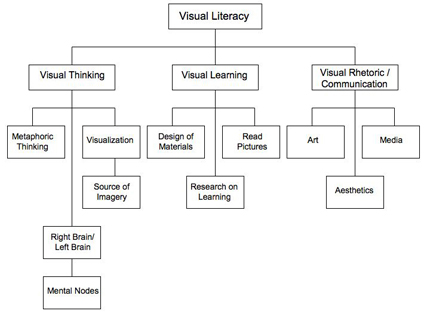
These visual arguments can be classified as, more specifically, visual rhetoric because of their motivation to convince the audience to react in a particular manner to the image. As seen in the image below from the Purdue Online Writing Lab (OWL) visual rhetoric falls under the umbrella of visual literacy along with visual thinking and visual learning.
However, not every image you come across can elicit responses and action from an audience. "The illustrations you use, the charts or graphs that make up a presentation, and even the photographs you place within a design will have significant impact to whether an audience takes you seriously" ("Visual Rhetoric: Use of Images," n.d.).
In conclusion, images can have a huge impact on our attitudes toward social and emotional topics. In our digital world, digital, and most times, visual arguments will fill our feeds as we go about our day. As we come about these images, let us observe them and allow them to let us feel something, respond in a particular way. And when we want to create our own argument, let us choose a powerful image that can convey a powerful message.
References
Hill, M. (2013, April 25). Visual Arguments. Retrieved from https://www.youtube.com/watch?v=xCYf3J88EzA
Turner, K.H., & Hicks, T. (2017). Argument in the real world: Teaching adolescents to read and write digital texts. Portsmouth, NH: Heinemann.
Visual Rhetoric: Overview. (n.d.). Retrieved from https://owl.purdue.edu/owl/general_writing/visual_rhetoric/visual_rhetoric/index.html
Visual Rhetoric: Use of Images. (n.d.). Retrieved from https://owl.purdue.edu/owl/general_writing/visual_rhetoric/visual_rhetoric/visual_rhetoric_images.html


